
KiriSense Industry Insight | Humanoid Robotics
Humanoid Robotics Is Raising Billions. The Next Challenge Is Dexterity.
Investors are pouring capital into humanoid robots and Physical AI. The next challenge is enabling robots to interact with the physical world with human-like precision.
By KiriSense Ltd · Published June 2026 · Updated 6 October 2026. Commercial lead: Tim Harper. Investment figures below describe the original June article’s context.
The humanoid robotics sector has reached an inflection point.
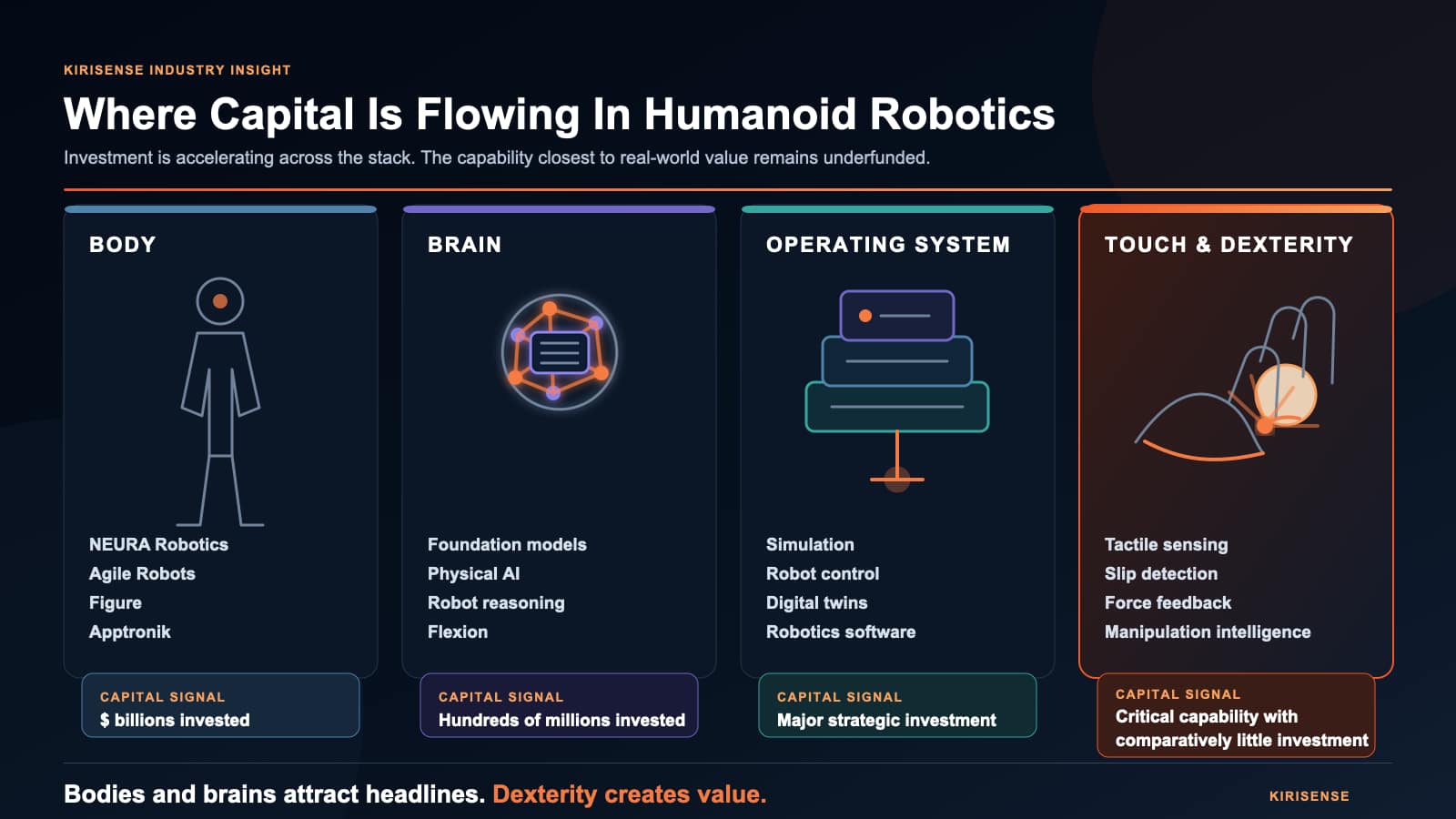
In recent weeks, investors have committed extraordinary sums to companies building the next generation of humanoid robots. NEURA Robotics announced a Series C financing round of up to $1.4 billion. Agile Robots is reportedly discussing an approximately $800 million funding round. Flexion recently raised $50 million to develop AI systems for humanoid robots.
Taken together, these investments signal something important. The debate is no longer whether humanoid robots will become commercially relevant. The debate is now about how quickly they can be deployed at scale.
From Research Project to Industrial Platform
The appeal of humanoid robots is straightforward.
Factories, warehouses, hospitals, farms and distribution centres have been designed around human workers. Doors, tools, shelving, workstations and vehicles all assume a human form factor.
A humanoid robot can potentially operate within these existing environments without requiring extensive redesign of infrastructure.
This creates an opportunity for a new generation of flexible automation capable of performing a wide variety of tasks rather than a single repetitive function.
That potential is attracting investors, industrial companies and technology firms alike.
Walking Is No Longer The Problem
A few years ago, locomotion dominated robotics research.
Today, many humanoid platforms can walk, balance and navigate complex environments with increasing reliability. AI models continue to improve at an extraordinary pace, while computing hardware becomes more capable and affordable every year.
The challenge is increasingly shifting elsewhere.
The next frontier is manipulation.
Picking up a rigid box is relatively easy. Picking up a soft strawberry, a slippery plastic package or a fragile electronic component is much harder.
These are precisely the types of tasks that create value across logistics, food processing, manufacturing, healthcare and agriculture.
Why Touch Matters
Humans perform these tasks effortlessly because we possess an incredibly sophisticated sense of touch.
Every second, our fingertips provide information about pressure, texture, movement and slip. Without consciously thinking about it, we continuously adjust our grip to match the object we are handling.
Most robots do not have access to this information.
Vision systems can identify an object and estimate its position. They struggle to determine how firmly it should be grasped, whether it is slipping or whether excessive force is being applied.
As robots move into less structured environments, this limitation becomes increasingly important.
The future of robotics is not simply about seeing the world. It is about feeling it.
Building The Sense Of Touch For Robots
At KiriSense, we believe tactile sensing will become one of the foundational technologies enabling the next generation of robotics.
Our kirigami-inspired optical tactile sensors are being developed to provide useful contact information for robotic manipulation. The architecture is designed for compact tactile signals; low latency, validated slip detection, durability and cost-effective manufacture are development goals; the demonstrated proof of concept distinguishes normal and shear optical responses.
The goal is simple: enable robotic systems to interact with the physical world with greater confidence and precision.
Potential applications include:
- Warehouse and fulfilment automation
- Food handling and packaging
- Agricultural harvesting and sorting
- Collaborative robotics
- Healthcare and assistive robotics
- Humanoid robot manipulation
As the industry moves beyond pilot projects and demonstration videos, the ability to handle real-world objects reliably will become increasingly important.
Following The Market
The recent wave of funding demonstrates strong confidence in the future of humanoid robotics.
Billions are now being invested in robot bodies, AI models and physical AI platforms.
The next question is how these systems will safely and reliably interact with the physical world.
That is where tactile sensing enters the picture.
The companies that solve dexterity may ultimately prove just as important as the companies building the robots themselves.
Because in robotics, intelligence matters.
But so does touch.
Technology and research evidence
Fingertip feedback in dexterous hands explains the engineering need. KiriSense’s proof-of-concept report separates current results from planned product development.