
Applications

KIRISENSE APPLICATIONS

Applications

Where tactile sensing turns vision‑only demos into deployable automation — real manipulation challenges that Kirisense technology is designed to solve.

The challenge: objects vision can’t handle

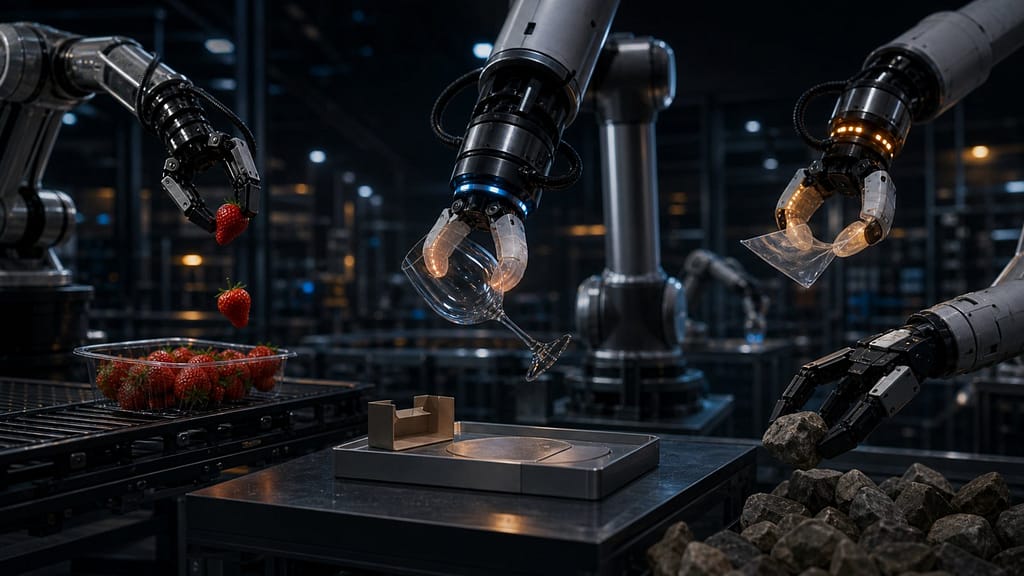
Across food production, warehousing, agriculture and lab automation, the same pattern repeats: vision‑only systems fail when objects are soft, irregular, reflective, transparent or tightly packed. Suction cups can’t grip porous bakery items. Parallel‑jaw grippers crush ripe tomatoes. Waste sorting robots misclassify materials that look identical but feel different.

These aren’t edge cases — they’re the majority of real‑world handling tasks. Tactile feedback closes the loop, providing the contact information robots need to adjust grip force, detect slip, confirm placement and recover from failures without restarting the entire pick cycle.

Where we focus first

Kirisense is exploring proof‑of‑concept partnerships in five sectors where tactile sensing delivers immediate, measurable value.

Application 1

Food & agri‑food automation

Fresh produce, bakery products and ready meals vary in ripeness, firmness and surface texture. Bruising from excessive grip force creates waste and rejects. Insufficient force causes drops. Vision alone cannot measure compliance or detect the micro‑slip that precedes a failed grasp.

Where Kirisense fits
  • Real‑time pressure feedback prevents bruising on soft fruit and delicate bakery items.
  • Kirigami‑enabled conformability wraps around non‑uniform produce and packaging.
  • Texture and pressure cues help distinguish firm vs soft items without destructive testing.
  • Food‑safe sensor materials support direct contact with ready‑to‑eat products.
Impact

Tactile feedback enables gentler, more adaptive grasping, reducing waste from bruising and improving pick success rates on items that currently require human touch.

Application 2

Warehouse & e‑commerce fulfilment

Mixed‑SKU picking involves pouches, flexible packaging, polybags, soft goods and reflective surfaces that confuse vision systems. Suction cups fail on porous materials; rigid grippers can’t adapt to varying thicknesses, leading to elevated pick failure rates and costly manual intervention.

Where Kirisense fits
  • Tactile confirmation of grasp on flexible packaging before lift prevents mid‑air drops.
  • Slip detection adjusts grip force when items start sliding in the gripper.
  • Texture cues distinguish polybags from cardboard, fabric from plastic for smarter handling.
  • Reliable manipulation from dense, mixed bins where vision is occluded.
Impact

Cutting pick failures by even a small percentage translates into thousands fewer manual interventions per shift in high‑throughput fulfilment centres.

Application 3

Agri‑robotics & harvesting

Robotic harvesting must distinguish ripe from unripe fruit by firmness, detect stems and apply precise detachment forces. Vision determines where the fruit is; touch determines how to handle it without damage in variable field conditions.

Where Kirisense fits
  • Pressure cues help estimate fruit firmness non‑destructively during grasp.
  • Shear‑force sensing guides twist‑and‑pull motions to detach fruit cleanly.
  • Optical sensing is immune to EMI and robust to changing outdoor lighting.
  • Flexible kirigami structures accommodate size variation within each crop.
Impact

Low‑cost tactile sensing makes it viable to add touch to harvesting end‑effectors, improving success rates on delicate crops and extending automation beyond greenhouse‑only deployments.

Application 4

Lab automation & life sciences

Pipetting, tube handling and sample manipulation demand precise contact control. Over‑insertion damages labware; under‑insertion causes assay failures. Vision‑guided insertion has tight tolerances but little feedback on jams, misalignment or completion.

Where Kirisense fits
  • Tactile sensing detects alignment errors and insertion completion in tube and vial handling.
  • Pressure feedback prevents cracking of glass vials and plastic consumables.
  • Contact confirmation verifies plate seating, lid closure and latch engagement without line‑of‑sight.
  • Sealed optical design supports cleanroom‑compatible implementations.
Impact

Adding tactile sensing to lab automation reduces mechanical assay failures and enables automation of tasks that currently remain manual because they are “too delicate” for robots.

Application 5

Waste sorting & recycling

Vision‑based sorters struggle with dirty, crumpled or visually similar materials. Plastic types, paper grades and metals can look alike even when their feel and thermal properties are very different, leading to contamination and missed recovery targets.

Where Kirisense fits
  • Texture and compliance help distinguish plastics, paper and metals that look similar.
  • Tactile sensing works even when items are dirty, wet or partially occluded.
  • Fast optical readout supports real‑time classification on conveyor systems.
  • Durable construction tolerates abrasive, high‑cycle contact environments.
Impact

Tactile‑enabled sorting robots reduce contamination, increase recovery rates and minimise hazardous manual picking in waste facilities.

Enabling safer human–robot collaboration

Beyond dedicated automation cells, tactile feedback plays a critical safety role in collaborative robotics where humans and robots share workspace. Optical tactile sensors provide:

  • Contact detection — immediate awareness when the robot touches a human or unexpected obstacle, enabling instant stop or compliant retraction.
  • Force regulation — maintaining safe interaction forces during co‑manipulation tasks such as collaborative assembly or co‑carrying.
  • Intent recognition — interpreting touch gestures for intuitive control (push to move, tap to stop, press to confirm).

As tactile interfaces evolve, they will support bidirectional communication — robots feeling the world, and humans feeling what the robot intends to do — improving both safety and task efficiency.

Why these sectors are ready for tactile automation

High manual labour cost

Food, warehouse and agri‑food sectors face persistent labour shortages and rising wages. Automation ROI improves when tactile sensing reduces failure rates enough to justify investment.

Vision‑only limits understood

Years of deploying vision systems have defined the performance ceiling. These industries know exactly where vision fails and where touch would add value.

Regulatory & safety alignment

Food‑safe materials, cleanroom compatibility and cobot safety requirements align with Kirisense’s optical design and silicone‑based, electrically isolated sensing surfaces.

Does your application match one of these profiles?

If you’re building robotic systems for food, warehouse, agri‑food, lab processes or waste sorting and you’ve hit the limits of vision‑only manipulation, we’d like to explore whether Kirisense tactile sensing could help.

Discuss your application
Scroll to Top